


Hello Rainmakers,
YFM Equity Partners has completed a management-led buyout that sees David Hall begin what he prefers to call a “slowdown” rather than his retirement.
Sheryl Moore speaks to Hall about succession, stewardship and what comes next after more than three decades on the investment frontline.
Rainmakers subscribers get two unique pieces a week, but also full access to our back catalogue of investigations, scoops, and insights, including updates from The Secret Investor, interviews with entrepreneurs, and the leaders from VC and PE investors like Endless River Capital, Foresight, Mercia, Puma and now YFM Equity Partners.
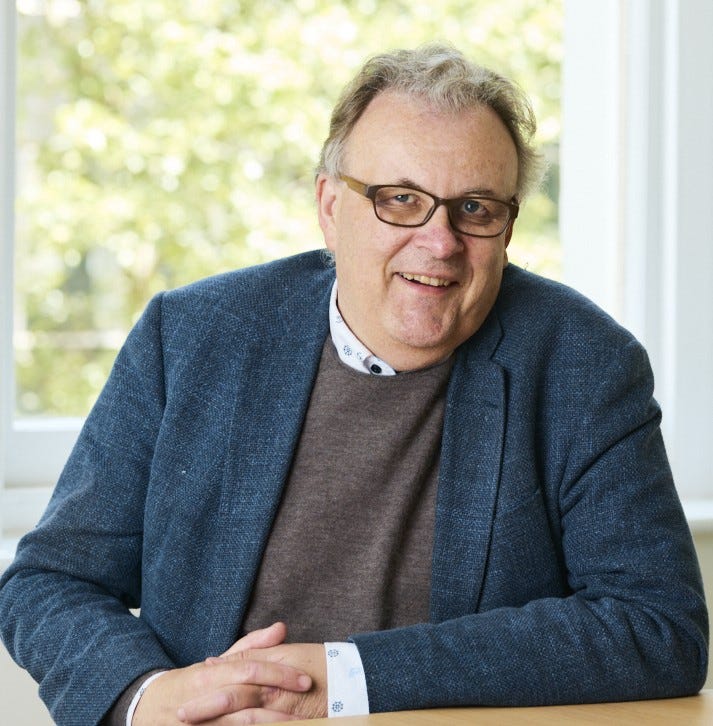
David Hall says he’s “chuffed”. It’s a rather Northern way to sum up a moment that, for most private equity leaders, would invite far grander language.
But after more than three decades at YFM Equity Partners – Hall’s understated verdict feels entirely on brand. The baton has been passed. The business is in new hands. And the man who helped turn a public sector backed regional fund into a quietly formidable national growth investor says just that.
“I think the word that I would use is chuffed,” he says, smiling at the end of a long journey that has been as much about stewardship as it has about returns.
That journey began long before Hall, who trained as a chartered accountant, arrived in 2000. By then, Yorkshire Fund Managers – as it was previously known - was already approaching its second decade. Born out of the Thatcher-era, it was one of a network of publicly backed regional development organisations designed to do three things for small businesses: give them somewhere to operate, give them advice, and give them money.
Nearly 40 years on, YFM Equity Partners is a very different animal. With around £800m under management, five offices across the UK and a track record that consistently places it among the top performers in its market, it has become one of the UK’s most influential lower mid-market growth investors – albeit one that prefers to operate without much noise.

Hall’s departure marks the end of one era and the beginning of another. But, true to form, YFM Equity Partners has taken its time getting here.
“To help small businesses, it was felt that you needed property, you needed advice and you needed money,” Hall recalls. “So, all these organisations were set up with three arms.”
Yorkshire Fund Managers was the county’s version of that model, sitting alongside peers such as West Midlands Enterprise – now Mercia.
Initially they invested local authority capital. But by the mid-1990s, the winds were shifting. Pension fund money began to sit alongside public capital, bringing with it a sharper focus on returns. In the late 1990s, they entered the newly created venture capital trust (VCT) market, tapping retail investors and edging further towards a commercial footing.
By the time Hall joined in 2000, the organisation was in transition. One of the last local authority funds was being wound up. Balance sheet capital was coming into play. And Yorkshire Fund Managers were starting to make small regional investments under its own steam.

Hall’s first specific task was to open YFM’s first office outside Yorkshire, in Manchester. Even then, the business was cautious about stretching its identity beyond county lines. A separate Welsh operation was launched under the banner of Wales Fund Managers, rather than exporting the Yorkshire brand wholesale.
“That tells you something about the mindset at the time,” Hall says. “Yorkshire sometimes thinks of itself as a country. There was a sense that it might not travel.”
That Welsh business would eventually become WestBridge Capital, now a well-established UK mid-market private equity house. Yorkshire Fund Managers own rebrand came later, following a pivotal moment.
In the early 2000s, Yorkshire Fund Managers still looked like a classic three-arm organisation: property, consultancy and equity. Senior figures sat at the top, each effectively running a division. Hall was firmly in the middle ranks.
Then the business decided to buy itself out of public sector ownership.
Almost overnight, Hall found himself propelled into senior leadership, becoming managing director of the equity division. The speed of the transition was dizzying, he says.
“I went home on the Friday reporting to one guy, and I came in on the Monday and he reported to me,” he says.
One of the people he leapfrogged, a senior colleague named David Gee, left a lasting impression. Quiet, principled and deeply fair, he embodied a leadership style that would shape Yorkshire Fund Managers’ culture in the years to come.
“One of the things I learned in business is that you need to make quiet voices heard,” Hall says. “They’re often some of the loudest.”
By the end of the decade, the original shareholders were approaching retirement. After years of building the business, they wanted to realise its value. Hall and his colleagues explored carving out the private equity arm, but the owners insisted on selling the group.
After a long and, at times, bruising process, the buyer emerged: Greater London Enterprise, now Newable.
For Newable, the deal was about more than assets under management. Yorkshire Fund Managers consultancy arm had achieved something Newable had struggled with – winning contracts nationally, not just within the M25. The two organisations’ advisory capabilities were complementary, one focused on sales and exports, the other on manufacturing and supply chains.
“The real reason they bought it was the consultancy,” Hall says. “They didn’t really buy it for the equity part.”
Following the deal, Yorkshire Fund Managers’ investment business was combined with other activities, including venture finance and seed investing. Hall was soon summoned to a meeting that set the tone for what followed.
“The group managing director said, ‘I’ve got three managing directors. I only want one. I’m going to pick one.’”
Hall emerged as the chosen candidate, tasked with consolidating three investment businesses into one coherent operation. The inheritance was far from straightforward. Many of the regional funds were underperforming, delivering losses to both investors and managers.
Over several exhausting years, the team sold off a vast portfolio of legacy investments, unwinding non-core activities and spinning out businesses that no longer fitted. One of those spinouts would become Seraphim Capital, now a listed specialist space tech investor.
In 2013, Hall, alongside David Bell and Paul Cannings, led a buyout of Yorkshire Fund Managers’ investment arm from Newable. The newly renamed YFM Private Equity was, for the first time, owned by the people who were running it.
At that point, the business was modest in scale: around £100m under management, roughly 15 investment professionals and a similar number of support staff.
Within a year, the new owners took a decision that would define YFM Private Equity’s future: to turn the firm into a partnership and offer equity to the wider investment team.
The logic was compelling. YFM Private Equity expected the management teams it backed to be aligned shareholders. Why should it be any different internally?
The reality was more complex. People at different life stages wrestled with what ownership meant for them. For a brief period, Hall wondered if he had made a terrible mistake.
Then something shifted. Conversations happened. Fears were addressed. And YFM Private Equity emerged as a genuine partnership, with shared upside and shared responsibility.
Over the past decade, YFM Private Equity has settled into a distinctive position in the UK market: a regional growth investor with national reach, a strong VCT franchise and a growing institutional fund base.
From Leeds, it has expanded into Manchester, Birmingham, Reading and London, which is now its largest office by headcount. Despite that footprint, it still does more deals outside the M25 than inside it.
Along the way, the firm has navigated every major economic cycle going: the dotcom crash, the global financial crisis, a decade of ultra-low interest rates and the pandemic.
Those cycles, Hall says, change the tone of conversations with entrepreneurs. Sometimes capital is abundant and cheap. At other times, discipline and focus are paramount. What doesn’t change is the importance of backing good businesses well.
Two investments, in very different sectors, illustrate YFM Private Equity’s approach.
The first is Go Outdoors. When YFM Private Equity invested, it was a single store in Sheffield, with a plan to open five more and sell. The team misjudged the opportunity – in the best possible way.
New stores didn’t cannibalise existing ones. The addressable market turned out to be far larger than expected. Then the financial crisis hit, flipping the property market on its head and allowing the business to secure large format stores on extraordinarily favourable terms.
By the time YFM Private Equity’s exited, selling to JD Sports, Go Outdoors had grown into a national chain with revenues of around £125m. The return – 37 times money – entered YFM Private Equity’s folklore.
“We had mats, mugs and all stuff printed with 37x on them, it was a huge deal for us.”
The second is Matillion, a data integration software business founded near Altrincham. YFM Private Equity backed it when revenues were barely half a million dollars. Today, it employs hundreds of people, serves global enterprise clients and is on track to exceed $100m in revenue.
For the business, Matillion is proof that a regional UK investor can help build a global software champion – and stay invested long enough to see it mature.
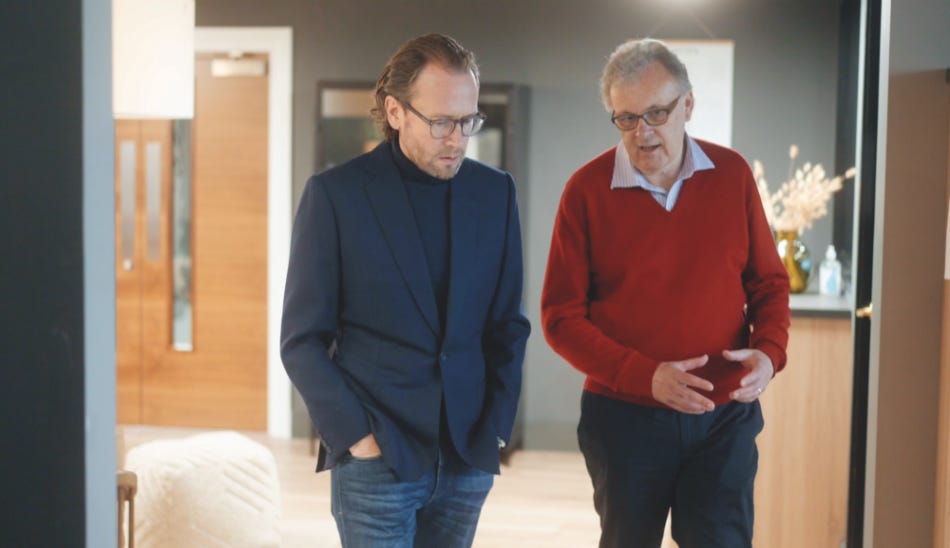
Despite those successes, Hall is acutely aware that YFM remains under-recognised in its Yorkshire heartland.
Its national funds, he notes, have ranked among the top performers in their market for two decades. “I don’t think many people in Yorkshire know,” he says. “And I think they should be really proud.”
Performance, however, is only part of the story. Private equity, Hall believes, is built on trust – from investors who commit capital for a decade or more, and from entrepreneurs who hand over part of their life’s work.
That trust is hard won and easily lost. Which is why succession at YFM Private Equity has been treated as a long-term project, not a single event.
The process began in earnest around 2019 when the management team was widened. Responsibility was shared. Then came the pandemic, which tested the next generation under fire.
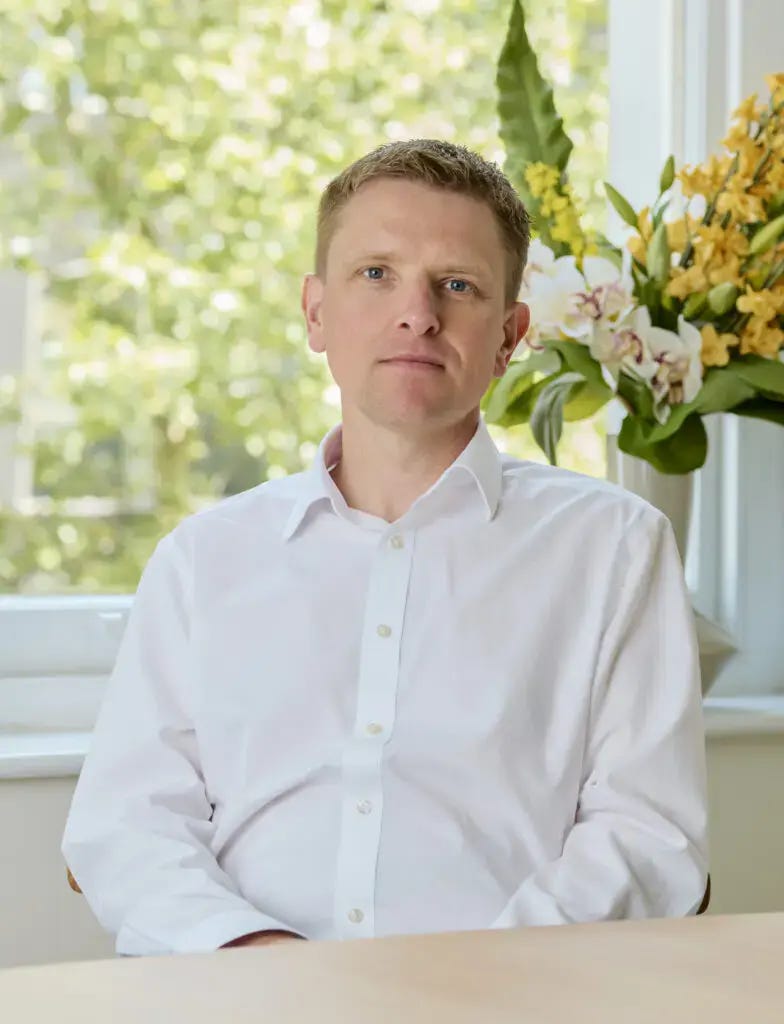
By late 2022, the operational reins were formally handed over to a new leadership trio: managing partner Jamie Roberts, head of investor relations Eamon Nolan, and CFO Marcus Karia. Beneath them sits a broader layer of regional and portfolio leaders.
For Hall, the true test of succession is simple. It’s the moment when investors stop calling him and start calling his successors – and are happy about it.
“That’s when you know the trust has transferred,” he says. “Then you’re like Elvis. My work here is done, and you’ve left the building”.
At 65, Hall is careful not to talk about retirement. Instead, he prefers the phrase “slow down”.
He will remain involved with YFM Private Equity for the next three years as a consultant, mentoring younger colleagues and acting as a sounding board. Beyond that, there will be travel, time with his wife Judith and a deliberate effort to simplify life.
There will probably still be spreadsheets too. What he won’t do is cling to a title. He has seen too many peers struggle with that transition.
“I’ve never defined myself by a job,” he says. “I just want to spend my time as well as I can.”
Hall describes YFM as his fourth child – something nurtured, challenged and eventually sent out into the world.
“It’s grown up,” he says. “It’s independent.”
The next chapter, he believes, matters not just for the firm but for the wider UK economy. More capital needs to flow into growth businesses. Investors need to back companies for longer. And returns need to come from genuine value creation, not just financial engineering.
YFM Private Equity, with its Yorkshire roots, partnership culture and new generation of leaders, is well placed to play its part.
As for Hall, his measure of success is characteristically modest. If investors are comfortable with the transition, if the business continues to thrive, then he’s happy. However, when pressed on whether his return on investment matched the 37x achieved by Go Outdoors, he remains firmly tight-lipped. “Let’s just say, I will be able to feed my family – and that’s all you’re getting!” While the figure he received remains under wraps, he will admit that he’s rather chuffed!”
::
The Rainmakers Summit on the 25th of March will feature a debate on the future of professional services as partners consider their next strategic options.
Featuring leaders of businesses who have chosen very different paths, and an investor in one of the consolidators driving the change across the sector, the debate will throw an intense focus on the stark choices that professional services firms face.
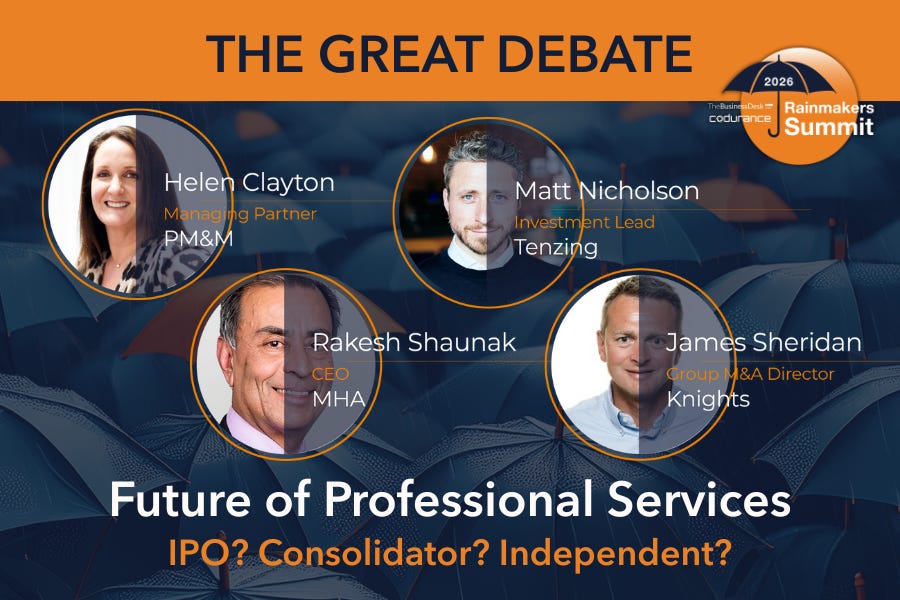
Making the case for independence will be Helen Clayton, managing partner at accountancy firm PM&M.
Telling the story about their respective lives on the public markets will be Rakesh Shaunak, CEO of MHA, and James Sheridan, head of M&A at Knights PLC.
Explaining the investment decision behind aggregation will be Matt Nicholson, investment lead at Tenzing, the private equity backer of accountancy consolidator DJH.
As a thank you for being part of our Rainmakers community, we are pleased to offer an exclusive 20% discount for the upcoming Rainmakers Summit on March 25th.
This is a unique opportunity to engage with industry leaders, gain insights, and connect with like-minded professionals.
As you can see the agenda features keynote speakers and exclusive sessions hearing from The Beauty Tech Group, Northern Gritstone, Rem3dy Health & GM Pension Fund. With some more details below…
Event details & registration:
https://www.rainmakerssummit.co.uk/
Discount code: RAINMAKER20
Please note that this offer is available for a limited time. We encourage you to secure your place at your earliest convenience.
::
Thank you for subscribing to Rainmakers.
We believe in good journalism that is worthy of your support. Please share this edition of Rainmakers so we can grow the message further and wider.
The insights and commentary we share with you are rooted in the trust we have built in the business community.
We’re also on LinkedIn - please join our Rainmakers community group for updates and offers and opportunities to comment.
If you have something you think we should look at, then either reply to this newsletter or email michael.taylor@thebusinessdesk.com.