


Hello Rainmakers,
This is a special report from the opening sessions of the UK Private Capital Summit down in that there London.
Rainmakers subscribers get two unique pieces a week, but also full access to our back catalogue of investigations, scoops, and deeper dives into sectors (like this one). We also bring you insights from The Secret Investor, and from leaders of VC and PE investors like Endless, BGF and WestBridge.
It took just two minutes into his opening speech at the UK Private Capital Summit for chief executive Michael Moore to push the buttons of the new Burnham government. To a backdrop of the day’s tag line “investing for a better economy” he casually dropped in “growth in every postcode” with the ease of someone stating the obvious.
Moore reminded the room (his paying members) that private capital is no fringe player but a national engine room: “We’ve got two and a half million people across the UK employed in private capital‑backed businesses… 90% of them SMEs, over half of them outside London.”
And he issued a quiet warning to policymakers about competitiveness and capital flight: “We have… over £200 billion pounds of dry powder available to UK investment managers to deploy across Europe… if it isn’t [attractive here], that capital goes elsewhere.”
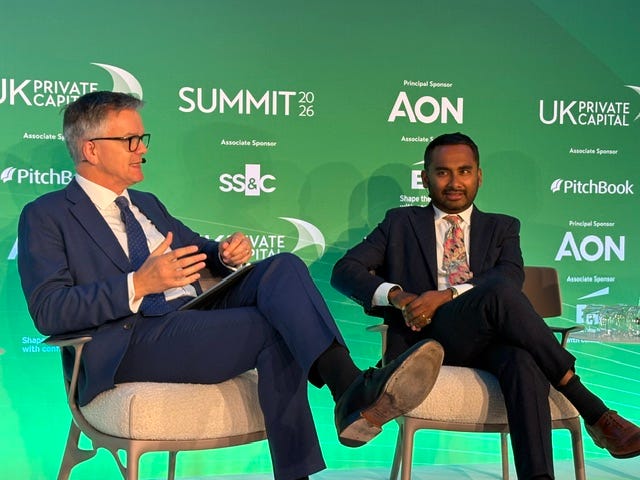
He then went on to build up to the showbiz early‑morning adrenaline shot, in the shape of Amol Rajan, in his first public on‑stage appearance since presenting the BBC Radio 4 Today programme for the last time on Monday.
Rajan arrived with the energy – and licence – of someone newly freed from BBC impartiality. Declaring it his “Liberation Day”, he told the room: “I do actually have a very strong opinion about private capital, which is that I really like it, and I really want more of it.”
As well he might to his (presumably) paying customers, and to potential backers of his own new media business The Amol Rajan Connection. From there he rattled through a lively 10‑point programme – less after‑dinner speech, more wake‑up call for a room full of allocators:
Wake up to a “century of change in a decade”
Politics and the civil service, he argued, are “hopelessly unequal to the challenges of today”, still wired for the last industrial revolution while AI, geopolitics and technology drive the next one.A hinge moment in history – from Gutenberg to Zuckerberg to GPT
Drawing on Niall Ferguson, he compared today to the age of the printing press – but with change compressed from “10 decades to 10 days”, and with AI soon doing it in seconds. We are, he said, living through not just “the Great Acceleration” but an era defined by violent jerks in the system.Broken contract between generations
The old assumption that children will be better off than their parents is gone. Real incomes have been flat for two decades and young people face a toxic trio of pay, property and pensions that leaves them worse off than their parents’ generation.Work no longer guarantees wealth
The post‑war deal – go to work, build a life – is breaking down. Today “capital begets capital”, and rewards flow to those with assets rather than those who simply work hard, fuelling the anger behind Trump‑era politics.Learning no longer guarantees earning
The graduate premium is shrinking, even as higher education expands. Rajan warned that AI could do to white‑collar jobs what globalisation did to blue‑collar communities – and asked what story we tell the next generation if “go to university and you’ll be fine” no longer holds.A reinvented, fragile family unit
Marriage rates for young adults have collapsed, fatherhood has been transformed, and a rising share of teenagers are not living with both parents. The family has changed more in four decades than in four centuries, with big social and economic consequences.A “golden age of stupidity” in the age of super‑intelligence
While machine intelligence explodes, human literacy and measured IQ are going into reverse. A post‑literate culture, fuelled by screens and snippets, is leaving politics “downstream of ever‑shallower attention spans”.From Bowling Alone to Scrolling Alone
Civic life is hollowing out. Trade unions, local clubs, religious attendance – all in decline. Technology has taken us from community activities to “scrolling alone”, feeding a relationship recession with serious mental health and political consequences, with a nod towards a big theme of Gordon Brown’s new book, The Future Starts With Us.A looming debt emergency
UK debt at £3 trillion and a state still addicted to consultations rather than choices. Rajan argued for reframing debt as a moral issue – why should today’s teenagers pay for yesterday’s political cowardice?We’re not doomed – but we need a better politics
Rejecting the Dad’s Army “we’re doomed” mentality, he called for a new politics that shifts tens of billions from unproductive to productive spending, and for a new compact with technology so that AI and digital tools expand agency rather than erode it.
Rajan’s provocations echoed the earlier fireside chat between Richard Swann and Sarah Adams. Where Rajan painted the macro picture of broken contracts and democratic drift, Swann and Adams had already made the case for private capital as part of the solution.
Swann’s own story – from a Sheffield council estate kid who “fell into the industry” to chairing UK Private Capital and leading Inflexion – was used to illustrate the sector’s social as well as financial impact. He talked about backing founders from seed through to international expansion, about private markets now representing 7% of UK GDP, and about the industry’s role in spreading ownership, creating jobs, and rewiring the mature economy.
Both conversations – the grounded growth narrative from Moore, Swann and Adams and the high‑voltage warning from Rajan – ultimately pointed the same way: if the UK is serious about “growth in every postcode”, a stable regime for private capital, pensions reform, and intelligent use of AI will be central to any credible plan.
::
As an industry body, still emerging from its previous identity as the BVCA, the summit attracted the attention of two front line politicians, a slightly subdued Mark Garnier from the Conservative Shadow Treasury team, then Labour’s City Minister, Lucy Rigby. The latter was never going to leak the Budget, but everyone was trying to read into what she was hinting rather than roaring from the stalls at a barnstorming address, which it wasn’t.
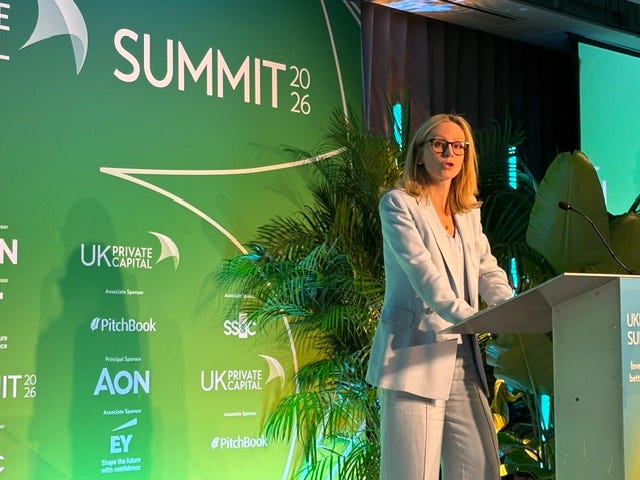
Rigby reaffirmed the government’s dedication to the Financial Services Growth and Competitiveness Strategy launched last year. The focus remains on strengthening the UK’s position as a global financial centre and ensuring financial services support the real economy.
On the Mansion House Accord she said efforts continue to drive pension consolidation and support long-term investment.
She said proposed reforms to the Alternative Investment Fund Management Regulations aim to streamline the regime via the FCA. Additionally, a package of reforms for VC fund managers is being developed to better calibrate rules to their specific activities.
Sitting in the front row Moore seemed happy to soak up the vibes.
::
A shuffling of the running order allowed Professor Ian Chapman, one year into his term at UK Research and Investment, who said he wants a sea change in the relationship between the academic projects he funds, and the people in the room who could invest further down the line.
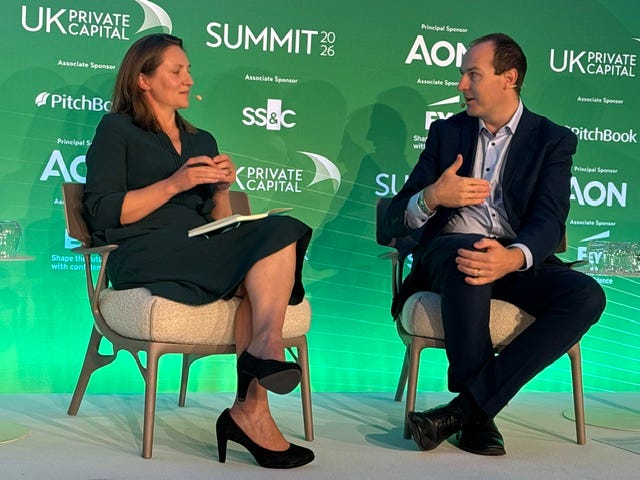
He issued an invitation for industry experts to participate more actively in the ecosystem noting that historical advisory panels have relied too heavily on technical experts rather than commercial ones, and offering better clarity on its portfolio, helping investors with due diligence and connecting them directly to emerging companies.
::

We have great pleasure in opening up ticket sales for a series of Rainmakers lunches starting with the Birmingham lunch on the 23rd of September 2026 at Regina’s in Birmingham.
::

::
Thank you for subscribing to Rainmakers.
We believe in good journalism that is worthy of your support. Please share this edition of Rainmakers so we can grow the message further and wider.
The insights and commentary we share with you are rooted in the trust we have built in the business community.
We’re also on LinkedIn - please join our Rainmakers community group for updates and offers and opportunities to comment.
If you have something you think we should look at, then either reply to this newsletter or email michael.taylor@thebusinessdesk.com.
Rainmakers is a reader-supported publication. To receive new posts and support our work, consider becoming a free or paid subscriber.