


Hello Rainmakers,
Gordon Brothers paid £1 for Poundland in June 2025. Just over a year on, the Boston-based turnaround investor is trying to sell it. And the queue of buyers forming behind it says more about how Britain’s high street actually gets rescued than Poundland’s own numbers do.
Rainmakers subscribers get two unique pieces a week, but also full access to our back catalogue of investigations, scoops, and deeper dives into sector trends (like this one). We also bring you insights from The Secret Investor, and from leaders of VC and PE investors like Endless, BGF and WestBridge.
Poundland’s results have been rough. It made an £85m pre-tax loss in the year to September 2025, and has since closed around 170 stores and cut more than 2,000 jobs.
Gordon Brothers says the business is recovering, and it has returned to like-for-like sales growth. The retail trade union Usdaw isn’t convinced, and has warned that Poundland could fall into administration, putting around 12,000 jobs across 600 stores at risk.
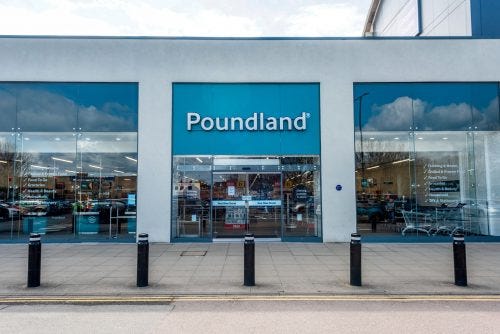
What’s notable is who’s circling. Chris Dawson’s CDS Superstores, which already owns The Range, Wilko and Homebase, is in the mix. Irish property investor Martin Property Group wants the whole business, and has the backing of Poundland’s own management team. Fortress Investment Group, owner of Poundstretcher, has bid for up to 250 stores, while Modella Capital, owner of Hobbycraft and TG Jones, has also expressed interest. B&M and Lidl are said to be picking over a handful of individual sites rather than the whole chain. Restructuring advisers Alvarez & Marsal are running the process, with a deal expected within weeks.
None of these names are new to distressed retail. Gordon Brothers bought Laura Ashley’s brand out of administration in 2020, then sold it on four years later. Hilco Capital, the former owner of HMV, bought Homebase for £1 in 2018 after Wesfarmers wrote it off. CDS later picked up Homebase’s brand and stores when it collapsed again in 2024.
A nominal sale like that isn’t a bargain so much as a transfer of risk. The buyer takes on a loss-making business and its liabilities, pays nothing upfront, and commits fresh capital on its own terms instead. Sellers get to stop the bleeding immediately. Buyers get a business they can reshape without paying a premium for the mess they’re inheriting. It’s a playbook, and the same small group of investors keeps running it.
Follow the money
The £1 is the least interesting number in the deal.
When Gordon Brothers bought Poundland, it also committed up to £80m of financing to fund the turnaround. Pepco didn’t walk away entirely either. It kept a minority stake, and agreed to provide an overdraft of up to £30m.
Now Gordon Brothers is reportedly demanding that any buyer repays a £30m shareholder loan in full, a loan it acquired for just £1 as part of the original deal. Martin Property Group’s offer would follow a similar pattern, paying as little as £1 for the equity, but repaying existing loans and putting millions more into the business.
In other words, the headline price tells you almost nothing. What matters is who carries the debt, who funds the recovery, and who gets paid first when the business changes hands again.
What happens after the £1
The more uncomfortable question is whether the playbook actually works.
The track record is mixed. Homebase survived its £1 sale for six years, before falling into administration again and being carved up, with CDS taking the brand and up to 70 stores. Wilko and Laura Ashley both live on as brands, but lost most of their shops along the way. And Claire’s Accessories fell back into administration just months after securing a buyer for part of its UK business, a point David Kemp, director at Liquidation Centre, has made about Poundland’s prospects.
That’s why the bids for Poundland matter so much. Broadly, the £1 club splits into two camps.
Some buy the brand, along with a website and customer base, and leave most of the stores behind. Others buy the shops and the people, betting they can run them better than the last owner. A sale of the whole business would keep Poundland’s stores and staff largely intact. A break-up would almost certainly mean a pre-pack administration, and hundreds of empty units.
The advisers
The original Poundland sale also had more structure than the £1 headline suggests. Slaughter and May advised seller Pepco, with restructuring partner Ian Johnson, corporate partner Alex Dustan and banking partner Susan Hughes on the deal. DLA Piper advised Gordon Brothers, led by restructuring head Rob Russell alongside partners Jonathan Richards, Joseph Frew and Gavin Smith, on both the acquisition and the £80m of financing, part of a restructuring plan sanctioned by the High Court in August 2025.
Whoever ends up with Poundland, the bigger story isn’t this one deal. It’s that the same small group of investors increasingly decides which chains survive on Britain’s high street, and which only survive as a name on a website.
::

::
Thank you for subscribing to Rainmakers.
We believe in good journalism that is worthy of your support. Please share this edition of Rainmakers so we can grow the message further and wider.
The insights and commentary we share with you are rooted in the trust we have built in the business community.
We’re also on LinkedIn - please join our Rainmakers community group for updates and offers and opportunities to comment.
If you have something you think we should look at, then either reply to this newsletter or email michael.taylor@thebusinessdesk.com.
Rainmakers is a reader-supported publication. To receive new posts and support our work, consider becoming a free or paid subscriber.
