


Hello Rainmakers,
Those of us used to covering Budgets over the years have been well used to Budget Bingo during the Chancellor’s speech - “strong and stable”, “all in it together,” and yesterday’s double figures use of the term “breathing space” by the present holder of the red box, John Healey.
What is maybe a newsroom in-joke is the predictability of the responses from the hundreds of comments that flood into news feed once the Chancellor has sat down - “pulled a rabbit out of the hat,” or “kicked the can down the road,” or a common critique of Gordon Brown’s Budgets - my own personal favourite - “the devil is in the detail”.
Except yesterday, it was true.
Rainmakers subscribers get two unique pieces a week, but also full access to our back catalogue of investigations, scoops, and deeper dives into policy issues (like this one). We also bring you insights from The Secret Investor, and from leaders of VC and PE investors like Endless, BGF and WestBridge.
The 56 minute speech by a Chancellor is the briefest executive summary - and spin - of a long and complex document. It’s unwise to ignore major plans that are otherwise only revealed in the actual lengthy 166 page Budget 2026 document, but the detail can indeed mask the reality of a detailed and complex policy.
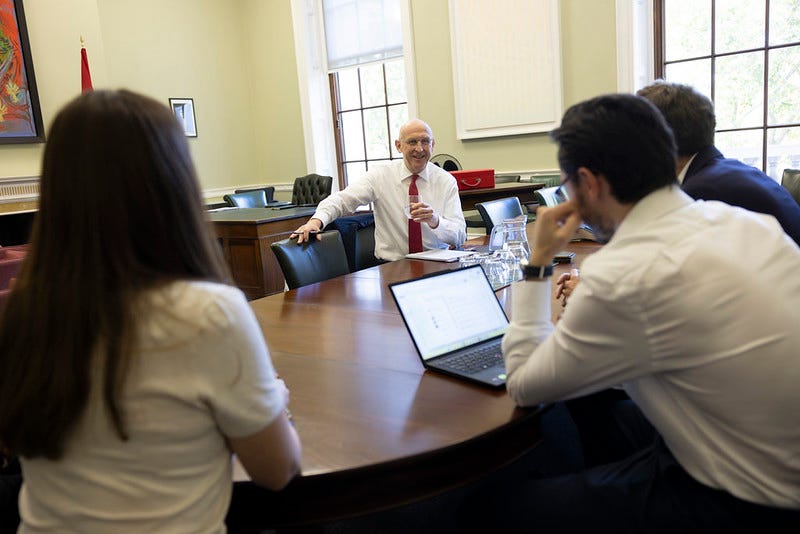
Yesterday’s budget introduced some highly encouraging proposals for the UK startup ecosystem. I was sat in the meeting room at accountancy firm DSG in Castle Street in Liverpool, with members of the DSG team from corporate and tax, along with a few partners from law firm Napthens.
After love bombing business leaders and entrepreneurs at the start, Healey’s calm and slightly soporific delivery had us in quite a chilled mood until about half way through, when he turned to entrepreneurs and how he planned to help.
A typical reaction was that of Duncan Johnson, chief executive of Northern Gritstone, which backs spinouts from northern research universities. Since the get-go, he has been promoting the re-introduction of the Blair/Brown era Entrepreneur’s Relief regime to support today’s founders. “Listening to the Chancellor set out the Founder’s Relief scheme was therefore music to my ears,” he said.
UK Private Capital Chief Executive Michael Moore said Healey had “heeded our calls” for action to strengthen the incentives for successful entrepreneurs to put their capital and experience back into the next generation of businesses - and the new Founders’ Relief should do just that.
Similarly, Dave Foreman, CEO of PXN Group liked the sound of the new founders’ relief and felt it was exactly the right instinct. “Every successful exit is a chance to fund the next generation of businesses, and keeping that capital circulating in the regions that produced it is how strong ecosystems are built. The new scale-up programme for women founders will help widen that pipeline too,” he said.
However, sat opposite me was Keiran Donovan, a corporate finance partner at Napthens, and his colleague Farida Isaji, a Partner and the Head of the Wills, Trusts, and Probate team, who both gave off sceptical vibes.
She had already flagged in pre-Budget commentary that she was watching closely for any further changes affecting business assets, capital gains tax and investment, and that clients are worried that CGT rises could stifle investment and growth.
To my right was Mark Kearsley, tax partner at DSG.
Within minutes, Kearsley quickly dug into the technical consultation to finalise the design. HM Treasury is currently pushing this through a fast-track consultation period, which closes on 30 November 2026, and the legislation is expected to be introduced in the Finance Bill 2026/27, with the relief applying to disposals after 6 April 2027. The relief reinstates the familiar 10% CGT rate with a lifetime allowance of £10m.

He explained to us how the consultation will provide the initial thinking of the Government as to the conditions which must be met to qualify. Individuals must hold 25% of the company’s ordinary share capital at the point when the trading activity commences. The shares must be held for at least five years before disposal and the individual must be a UK tax resident for at least five continuous tax years.
The company must have turnover of £10m or more and have at least 15 qualifying full-time employees in the accounting period prior to disposal. The biggest challenge will be meeting the growth and innovation conditions, where two of three must be met. These are the turnover test, headcount test and innovation test. The first two look for a 25% compound growth in the respective measure over the last 10 years, and the innovation test requires qualifying expenditure of £1.5m or more over recent years.
His hot take: “Whilst this may apply to some shareholders considering an exit after April 2027, the growth and innovation conditions could make this inaccessible for most.”
The view from Keiran Donovan was initially enthusiastic, describing it as a “significant recognition of the financial and personal risk entrepreneurs take in building businesses and appears designed, at least in part, to encourage successful founders to start, build and retain their businesses in the UK.”
When he looked at the detail, he too started to detect some some mixed messages. “Businesses and their owners need a tax system that is predictable, competitive and rewards long-term investment. Continued uncertainty around potential tax rises on dividends does little to provide that certainty,” he said.
And as Farida Isaji had warned, a reduction in the BADR threshold from £1 million to £500,000 appeared to contradict what businesses had been led to expect only last week. “We will also need to see the detail of the proposed reliefs for succession planning in family businesses, which will be important for owners considering how and when to pass businesses to the next generation,” she said.
In similar rooms right across the country, the penny was starting to drop, particular amongst venture investors who had started to get excited.
Notably, that the British Business Bank will receive a further £5bn in funding, with the lion’s share directed at startups and scale-ups.
But as Keith Benson at DSW Ventures noted, “ostensibly, this sounds fantastic. A 10% CGT rate for founders exiting innovative businesses is a great headline for the ecosystem. However, once you dig into the details, this starts to look like a flawed piece of legislation that fails to create the right incentives for our most strategic sectors – including almost every UK university spin-out.”
For the uninitiated, DSW Ventures is a pre-seed to Series A investor in deep tech, AI, and tech-enabled companies. Benson therefore has a front-row seat to the realities of early-stage company building.
His conclusion is that while these rules clearly define a certain type of growth business, they will fail to capture many of our most strategic technologies. “A B2B software business building an AI wrapper for a relatively undifferentiated and non-defensible, and as a result, non-strategic, sector will likely qualify. A deep-tech team commercialising transformational university research in quantum computing or oncology almost certainly will not,” he points out.
He lso fears that has it’s currently designed, most spin-outs will not qualify, and even if they do, the people charged with driving the value will be excluded. “By the time preparation for trade commences – often when a VC coalesces the first real funding round – the cap table is already quite busy. You have the university, VCs and angels, the academic inventors, and a founding management team of two to four people who will take the business forward,” he said.
He’s also worried there’s a bio-tech blindspot because many pre-revenue businesses, or early stage firms haven’t hit £10m in turnover, their founders would not qualify. “How are these companies not some of the most strategic assets for the UK economy?”
His view on a potential solution is that relief should be anchored to value creation in strategically critical sectors and available to all founders.
“If a founding team builds a high-tech business and exits for (say) £25m+, it shouldn’t matter if that value was created in two years or five, or whether it was pre- or post-revenue. The entire founding team – the people who were in it from the start and sacrificed their personal and professional lives to build something from nothing – should qualify. We are asking them to keep the UK relevant in the future global economy – we should reward them accordingly when they succeed.”
It’s a fast track consultation, so there’s a limited window to make a case. But as we discovered yesterday, details matter.
::

::
Thank you for subscribing to Rainmakers.
We believe in good journalism that is worthy of your support. Please share this edition of Rainmakers so we can grow the message further and wider.
The insights and commentary we share with you are rooted in the trust we have built in the business community.
We’re also on LinkedIn - please join our Rainmakers community group for updates and offers and opportunities to comment.
If you have something you think we should look at, then either reply to this newsletter or email michael.taylor@thebusinessdesk.com.
Rainmakers is a reader-supported publication. To receive new posts and support our work, consider becoming a free or paid subscriber.