


Hello Rainmakers,
With the spotlight on Greater Manchester Mayor Andy Burnham standing in the Makerfield by-election, and taking the first step towards Parliament, party leadership, and maybe Downing Street, it’s worth taking stock of how he has operated around business, and what clues that gives us to what his curious blend of municipal socialism, Catholic Social Teaching and pro-business populism tells us about how he might govern.
Rainmakers subscribers get two unique pieces a week, but also full access to our back catalogue of investigations, scoops, and insights, including updates on wider trends, like this one, insights from The Secret Investor, interviews with entrepreneurs, and with leaders from other VC and PE investors like Endless, BGF and WestBridge.
When I invited Andy Burnham to speak at the Rainmakers Summit in 2025, he listened to my pitch, recognised a few key names in this world that I mentioned who I knew he had engaged with - Gary Tipper, Michael Moore, and Paddy Dowdall, then of the Greater Manchester Pension Fund - and we shook on it.
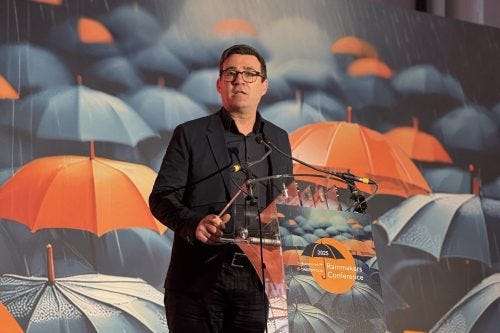
A few months later, he arrived at Emirates Old Trafford with barely minutes to spare until showtime, happily posed for photos, didn’t need a speech, or an autocue, and spoke for fifteen minutes without notes. But he was absolutely on point to the 400-strong audience of corporate finance professionals and business owners. He also seemed sensitive to issues around pension fund reforms, and keen that they don’t create a blockage in the investment in ambitious, growing companies across the region.
“We know there are issues that you will have on your mind about reforms to pension funds, and we have concerns about the consolidation of local government pension funds, because I know many of you have worked in partnership with Greater Manchester to invest via those funds,” he said.
“We will be absolutely ensuring whatever reform comes through, it doesn’t stop the investment coming down to those scale-up organisations in Greater Manchester, and we’ll work with you to make sure that happens.”
He also recognised the crucial role that Rainmakers play in creating employment opportunities and economic growth.
He said: “My first job is to thank you all most sincerely for what you do to back businesses across Greater Manchester and the North of England and build wealth here, bring jobs and prosperity here.
“Often it goes unnoticed – and perhaps you don’t think people like me notice it, but we do – and we appreciate what you do and your commitment to this wonderful part of the world.”
He looked ahead to what he hopes will be “the best decade we’ve seen in 100-plus years in Greater Manchester” as the momentum continues to deliver investment at scale.”
Burnham said: “We are about to agree with our leaders and hopefully with the government in the Spending Review, a 10-year investment pipeline for our city region, where we build more capability at the centre, so that we can bring those big regenerations through, like at Old Trafford and Atom Valley.
“We are saying to the government, we want to be investing at least £1bn, but more likely £1.5bn, a year for the next decade, in Greater Manchester’s infrastructure, but in our sectoral and industrial development as well.
“And we want to work with all of you, because we want to maximise that investment opportunity, we want to make it as coherent as possible for you with the kind of locations where we’re prioritising the green economy, or where we’re prioritising advanced materials, like we did with Media City a number of years ago.”
“We believe you create more of those global clusters across the city region that creates the potential for the spin outs that you will want to back. And we want to get all potential investment partners lined up together with us and in the mix.
“For me, this is our moment, and we mustn’t miss it.”
Burnham, who is now in his third term leading Greater Manchester, is often bullish about the rate of growth in the city region, which is averaging just under 3% since 2015.
“I don’t think we’ve ever lived in a more exciting moment in Greater Manchester in our lifetimes, because the change is visible if you look at the skyline of the city, and that reflects an incredible decade,” he said.
“It’s a growth story that is increasingly being noticed now, both here and around the world.”
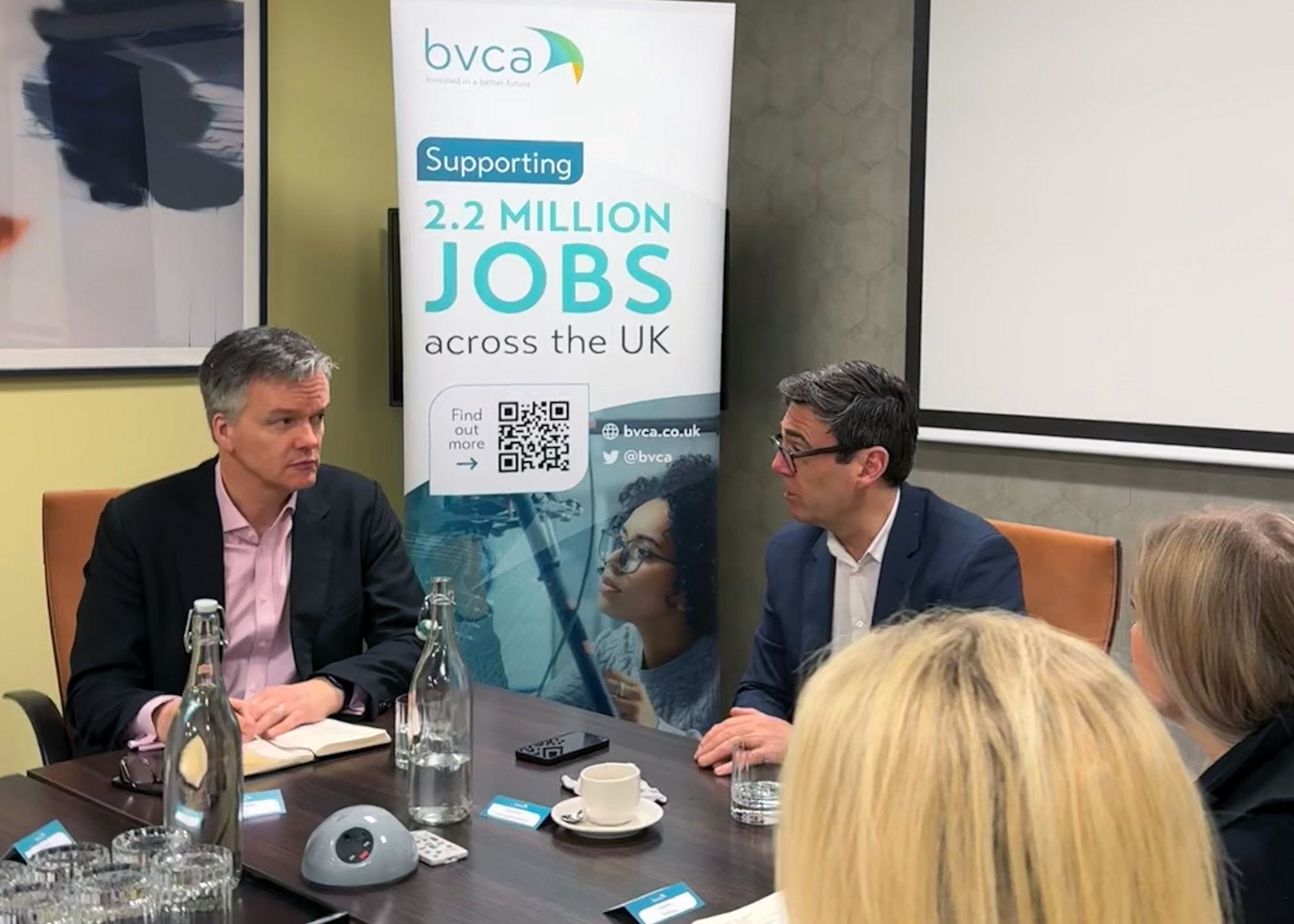
The same warm reception greeted a similar public appearance at the office opening for Alvarez and Marsal a few weeks before that. And when he attends careers fairs charity events, faith groups, sports clubs, train stations and universities. His speeches are always mindful of the audience, and often delivered without notes.
And that’s precisely that tactile and sensitive empathy that might just get him over the line in a tough by-election, and precisely why Labour MPs from all corners of its board church see him as a saviour.
But given how Britain seems to turn on its Prime Ministers, how will he ensure that his journey can be from hero in these settings into the seemingly ungovernable mess of a nation of ours.
Often teased as a political chameleon, in his first Westminster stint Burnham served as Chief Secretary to the Treasury, Culture Secretary, then Health Secretary in Gordon Brown’s Government by the time he turned 40. Now, 16 years later, his political CV includes nine years as Mayor, as well as two failed Labour leadership campaigns as well as one stymied comeback run in January of this year.
Yet ever since Burnham announced that he was walking away from Westminster to run for Greater Manchester Mayor, he’s been careful to maintain the national profile. His pitch to the Labour selectorate in 2017 was that this was “a cabinet level job” requiring someone of his calibre and experience, that he intended to make it bigger than it was designed to be. Once elected, after carving out a role for his loyal lieutenant Lee, one of his first major priorities was to hire a communications expert with lobby experience, in order to keep him in the spotlight. Though that didn’t pan out quite as intended - the successful candidate had an undeclared drug possession conviction, and left - throughout his first term Burnham made himself available for TV, newspaper and consumer media profiles.

At the time of his first election I was working for Manchester Metropolitan University, establishing a policy think tank called MetroPolis, while studying part time for a Masters degree in political science. My field of research was the emerging institutions of devolution, and the narratives surrounding an attempt at a new politics. The case study was Burnham’s first term from 2017 to 2021.
Come the pandemic, cometh the King. Amidst the chaos of the Johnson government’s handling of the lockdowns, the Mayor became a meme. Stepping to the mic on two memorable occasions and berating the callous way the North was being treated he was crowned King of the North for his interventions, something he did very little to discourage.
My thesis concluded that his brand of devolutionary politics was a genuine break with the Westminster way, and that while the rhythms of government were disrupted by Covid, the building of networks and narratives around a new politics and an antidote to the dysfunction of the centre made it a genuinely exciting project, but also one led by an empathetic leader.
I also noted that he had also cemented his profile and authority with a calm and unifying response to the devastating 2017 Manchester Arena terror attack.
People tend not to read academic papers, but it’s here if you want it. I initially wanted to build on the research and complete a more journalistic project. I pitched King of the North - Andy Burnham, Britain’s next Prime Minister to publishers. I got told it had limited to no appeal and that others, including Wigan MP Lisa Nandy, were also punting ‘new politics’ books into a crowded market.
It wasn’t planned as a soft soap biography, nor would it be a hatchet job. Since then Burnham himself has written his own book - Head North - with his pal Steve Rotheram, thus dealing with a lot of the trace elements of his political back story.
Highly personal at times, the Head North will have been pored over by profile writers keen for an insight from stories of football, music, and this radical new politics from the regions.

“We write about what the football meant to us, what the music meant to us, at a time when our cities were being dumbed down by the rest of the country,” said Burnham speaking alongside Liverpool’s Steve Rotheram at a long-arranged An Evening with the Mayors event in front of a sell-out and supportive Merseyside audience, just after he was blocked from standing in the Gorton and Denton by-election.
“That was the thing that kept pride and kept belief. We went to Westminster and tried to argue against some of that prejudice and the bias against the North that we’ve always felt in our lives. Honestly, we felt we came up against a brick wall, didn’t we?
“We broke through with Hillsborough just by force of the power of the people here. We were trying to give vent to their feelings.”
Maybe it’s time to revive my own book idea, given the trajectory Burnham is now on.
Re-elected on two subsequent occasions, Burnham has succeeded as Mayor because he’s been able to craft the scope of the role in his own image, and his own priorities.
Nowhere in the devolution agreement, negotiated before his time, did it say the Mayor had to tackle street homelessness, but Burnham has made it a policy priority. When I interviewed him for MetroPolis magazine in 2017 he said for Mayors “your real power is your soft power … convening power … the ability to unite people around a single agenda.”
The defining policy legacy may well be transport. Sir Richard Leese, former leader of Manchester City Council, said Burnham was “the price worth paying for getting control of the buses.” Leese also said he wasn’t personally interested in the role of Mayor because it was a PR role involving lots of glad handing on foreign visits.

In saying that, Leese underestimated what Burnham would do in the role and how he has mobilised the soft power of those global alliances to consolidate. Not only has that boosted the status of the Mayoral office, but Burnham’s own profile. Incidentally, such was his appeal at the SXSW music and tech event in Austin, Texas in 2019 that word went around the event that Manchester’s stand was worth checking out for no better reason to catch a flutter of the eyelashes of “Hottie Mayor.” For a time, HM was code for Burnham among a class of politicos.

I also put it to Burnham in 2023, on the Northern Spin podcast, which I sadly don’t do any more, that he was at his best when he was at his most Catholic. It’s a side of his political identity that doesn’t get talked about much, but he did admit that the influence of his political mentor Paul Goggins, the late MP for Wythenshawe, and a devout Catholic, was immense. “What’s the point of having power, if you don’t use it for the service of those who don’t?” he said. You see that in his advocacy for victims of tainted blood, for the homeless, and for the 97 who lost their lives at Hillsborough in 1989. And in his visit to the Vatican with his mum, and Bishop of Salford John Arnold, to meet Pope Francis.
The question now is this: has the Greater Manchester experience given Burnham nine years of preparation and learnings for what comes next, layered on the sixteen in Westminster before that?
Can Manchesterism - this Catholic-infused, man-of-the-people, soft power populism - work nationally?
On the soft power front, certainly the foreign visits and the refreshing approach to communications speak of a politician of the people. When he travelled to Dublin to meet with the government of Ireland in 2022 he was greeted by President Higgins as a head of state, just as relations with Boris Johnson’s dissolving administration were non-existent to outright hostility. His links with Mayors from Osaka to Austin, Paris to New York, are strong.
But since his lively first term he’s also learnt on the job too, sharpened his comms, changed the way he dresses, so he doesn’t look like a cardboard cut out politician, and he’s learnt to pick his battles.
His weekly radio phone-in and regular meet the public open events (of which I’ve chaired two, for full declaration) are folksy and genuinely raw.
He’s also swallowed a couple of lessons from tactical mistakes, notably over the introduction of a Clean Air Zone for the whole of Greater Manchester, where he was the focus of a backlash led by small business ‘white van man.’
If he has a weakness it’s probably a lack of cynicism in a cynical world. He has waded into social media rows defending loose associates who don’t deserve defending. His choice of advisers, in the early years, was poor. Days after his night time economy adviser Sacha Lord had resigned over flawed grant applications for one of his businesses, Burnham still went out to bat for him.
He has also been a lucky General in many respects. The Greater Manchester devolution journey that started in 1986, with the remaining institutions that survived the abolition of Greater Manchester County Council, stalled under Blair, was unleashed by George Osborne in 2014, and they underpin the economic success he has basked in. He has been humble enough to admit he stands on the shoulders of giants, but his role in the present day magnetism of the city region is undeniable.
The challenges he lays down to the Westminster broken system will require him pulling the levers that don’t always work, but also explaining quickly what he means when he says the country needs a constitutional “rewiring” and how that will improve decision making and pivot the state towards better outcomes.
He says he doesn’t like the adversarial bear pit of the Commons. In Greater Manchester he has limited scrutiny, and no formal ‘opposition’. He has worked with Conservatives and Lib Dems in his cabinet, and reached out to rival politicians to get them to work with him. He is a convert to proportional representation, and the consensual governance that would flow from that. Indeed, his motivation is to stop the march of Reform, which he sees as divisive to society, where he only wants to unite and heal.
So what is likely to be the ‘thing’ that the hysterical right wing media latch on to, that may even derail his progress? The Telegraph has already decided the weak points and intends to hammer them. They seem to think the loans to developer Renaker to build Deansgate towers will “cast a shadow” over him. The “bond markets” will be spooked by his critique of the Chancellor’s fiscal strategy. The Daily Mail, in whose pages the only good woman is an unhappy one, will no doubt make much of his wife’s job for a business that provides EV charging infrastructure. On his own campaign video this week he has addressed the Clean Air Zone change in plan, and his action to prosecute grooming gangs, which are issues that sceptical members of the public have raised with him
Opponents on the left might demand even greater criticism of Israel, though Burnham appeared to nip that in the bud when he condemned the brutality of the war on Gaza to the satisfaction of that lobby.
His first challenge is to win back to Labour the voters of the Makerfield constituency; if he does that then the next pool to convince will then be Labour’s 400 or so MPs. Depressed and defeated, let down by Starmer’s weak leadership, persuading over 80 of them to back his pitch for the leadership won’t be the issue, rather the task will be to dissuade enough of them NOT to back anyone else in order to ensure a smooth coronation and as painless a succession to Starmer as possible. A victory parade at the annual party conference in Liverpool in October would be sweeter than being banished from the platform, and being accused of show-stealing for ‘unhelpful’ fringe appearances, which has happened in the past.
Thinking back to that Rainmakers event in March 2025, just a few months into the life of the Labour government, and with an unpalatable Budget behind them. On paper, it was a tough gig, and there’s no politician - certainly not a Labour one - who could have taken to that stage and got the reaction he did then.
A whole new world of discontent and discord awaits every Prime Minister, it’s Burnham’s burden that he wants to turn the tide of history in his favour, and use that same charm on the toughest stages of them all.