


Hello Rainmakers,
A few summer reading recommendations for you.
The public view of private equity is important. Maybe not as important as the performance of portfolio companies, or the returns to funds, or an ability to raise capital in the future, but it is important nonetheless.
With a background as a journalist at the left-leaning magazine New Statesman, and the Guardian, Hettie O’Brien’s study of private equity in her new book The Asset Class, isn’t destined to be sympathetic.
The subtitle of the book makes that clear - ‘How private equity turned capitalism against itself’.
Rainmakers subscribers get two unique pieces a week, but also full access to our back catalogue of investigations, scoops, and insights, including talking points within the, like this one, insights from The Secret Investor, interviews with entrepreneurs, and the leaders from other VC and PE investors like Endless, BGF and WestBridge.
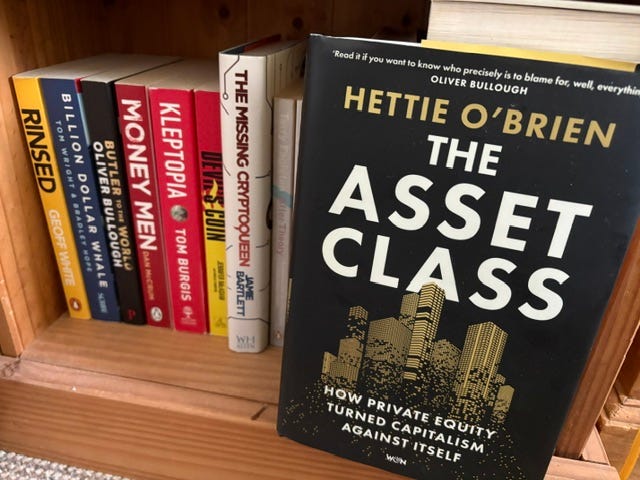
The core message running through The Asset Class should be heeded. It is a sector gaining in importance, but most members of the public are unlikely to know the names of the people and brands behind the companies they work for, the houses they rent. Not to mention hospitals, nurseries and care homes.
For decades, private equity firms have gained greater influence and reach. UK Private Capital’s own figures reports that private capital firms have invested nearly £25bn into over 1,400 UK businesses in 2025 alone.
How politicians might then make decisions about how to curb the worst excesses of the sector becomes fairly urgent.
We’ve covered the charm offensive on the incoming Labour government in some detail. And public affairs specialists from UK Private Capital have made their cases on various stages, including those we’ve built around this brand, Rainmakers.
To be fair, O’Brien stops short of the wilder accusations of what some of the above were up, and doesn’t overplay her hand in pinning those kind of crimes on private equity. What The Asset Class does do very effectively is chart the emergence of a hidden empire of billion-dollar deals and what she calls “covert financial warfare”.
The examples she picks on - housing and property in Copenhagen to tech investments in San Francisco, and the scandal of the UK water industry in the Yorkshire Dales - all follow the money, the ideological roots and the trail of destruction.
She identifies some of the founding fathers of modern private equity in the shape of William E Simon, President Richard Nixon’s former Treasury secretary, and his early zeal for using hefty debt to re-energise and motivate underperforming companies.

On this side of the Atlantic she fingers the role played by James Goldsmith and Jim Slater, who represented a challenge to the sleepy City of London with their own buccaneering corporate raider style.
The explanation of the use of debt to fund a purchase of an industrial asset is well explained, and the explanation of how this played out in the UK care home sector are distressing and uncomfortable.
The explanations of the fund raising and fee structure is illuminating and it’s either a comment on how opaque the methods of private equity are that much of it was new to me.
Overall, it paints a picture that this business model has started to infiltrate every corner of modern life. Wielding debt as a weapon, they push vital services into crisis. Their cover story: that this is merely the ‘creative destruction’ essential to growth. Old-school capitalists say they’re dismantling everything that made our economies work.
One of the sympathetic reviewers of the book - Simon Nixon, previously chief European commentator at The Wall Street Journal and chief leader writer and columnist at The Times, so we’re not talking Owen Jones here - reveals that in his own experience private equity people are arses.
“Some of the most disagreeable people I have encountered in three decades of financial journalism work in private equity,” he says.
I have a slightly different take from my own experience. Most of the people who will be walking up to the stage at the Rainmaker awards in Leeds, Manchester, Birmingham, Bristol and Nottingham are actually decent people.
Many of the funds in the regions we report on have deeply embedded social impact conditions on the funds that they raise. Many of the state-backed funds, designed to plug a gap in the need for growth capital, use the skills and services of the businesses that operate on a private equity gap model to deliver investment at scale.
Where there are genuine alarm bells are in how the use of debt reduces the performance of portfolio businesses whose only possible exit is to another private equity investor willing to make even more ruthless operational decisions to squeeze any remaining value out of a business.
We’ve also seen the accumulation of a vast barrel of ‘dry powder’ - which supposedly hit a peak of $2.62 trillion in mid-2024. That’s money raised and uninvested in businesses. Another figure that concentrates minds in general partners is the length of time private equity holds on to assets, or ‘hold periods’. According to Private Equity Info, that number has crept up from 4 to 6 years, but that economic disruptions (like the dot.com bust in 2003, the Great Recession in 2009, and Covid in 2020). These historical events have traditionally increased the median holding period by 1.0 to 1.5 years.
Another reviewer, my old friend Martin Vander Weyer, says her selective case studies, and over-simplification of the problems of the water industry weaken the book, but he does say it needs the industry to make their case ever better.
Rapacious long reads into the how the world really works have become a popular and ever growing segment of the publishing landscape, and my own bookshelf creaks under the weight of examinations into murderous oligarchs, legal bully boys, money launderers, as well as very specific tales like HSBC’s disgraceful washing of Mexican drug cash and the shambles of how financial disruptors like Greensill Capital and Wirecard got away with it for as long as they did.
But O’Brien’s well written and accessible book isn’t intended to be a well-balanced assessment of the sector, it reads like a case for the prosecution and is all the more compelling for it.
::
The 2026 Rainmaker Awards
The North West, Yorkshire and West Midlands Rainmaker Awards are upon us, once again bringing together the region’s deals community to celebrate the standout deals, teams, and individuals of the past 12 months.
Voted for by the corporate finance community itself, the awards are decided on a one-firm, one-vote basis – making the Rainmaker a genuine peer-led recognition.
Voting forms have landed, after the shortlists have been agreed by a judging day involving all the region’s leading firms.

The Rainmaker Awards ditch black-tie formality and speeches in favour of a relaxed evening focused on what the deals and the people who made them happen.
The evening is also a great way to connect with leading firms and individuals shaping the regional deal landscape.
There is a new individual category this year, as we will recognise Lifetime Achievement of one of our Rainmakers for the first time.
The North West awards will take place on the 25th of June 2026 at the Kimpton Hotel in Manchester city centre, and the West Midlands at the Burlington Hotel in Birmingham on the 2nd of July.
We have also now announced dates and an opening for entries for the East Midlands event on the 5th of November in Nottingham and the South West event on the 26th of November in Bristol.
Last years events sold out, so book early to secure your table.
::

::
Thank you for subscribing to Rainmakers.
We believe in good journalism that is worthy of your support. Please share this edition of Rainmakers so we can grow the message further and wider.
The insights and commentary we share with you are rooted in the trust we have built in the business community.
We’re also on LinkedIn - please join our Rainmakers community group for updates and offers and opportunities to comment.
If you have something you think we should look at, then either reply to this newsletter or email michael.taylor@thebusinessdesk.com.
Rainmakers is a reader-supported publication. To receive new posts and support our work, consider becoming a free or paid subscriber.